

So you use AI but your work with this fancy new tech doesn’t seem to make a difference in the real world, you're “doing things” more than “creating value.”
And no, your org hasn’t given you guidance, nor are you an IT expert. So you’re left to your own devices.
Where are you supposed to get better priorities, to make a difference with AI?
I don’t know your org. But f you haven’t gotten clear direction so far, you likely won’t get it anytime soon. You may need to pull yourself out of the morass by your own shoelaces. It takes “change ownership,” to talk nerdy.
Ok fine, but how?
Presumably, you’re already “using AI”
I’m assuming that you already are doing stuff with AI. So it’s not just a matter of “prompting more.” That’ll surely produce something useful at some point too. Practice accumulates. But who knows when.
Or, if you’re not doing anything much with AI yet, your first step is just to get started. And even before that, consider why you truly haven’t started yet, even though you’re reading something like this, meaning you think AI will matter to you. Anyway.
Let’s orient first
Hang around social media long enough, and you’ll see bunches of guides on how to use AI better. Unfortunately (even ignoring the obviously-stupid ones), many won’t help us here. They studiously avoid touching anything that is your actual work, instead preferring to suggest related things like classes, immersions, and the like that are useful but don’t create work value.
We need something that is part of your work. It’s your work that produces value, and value is what we’re hunting for.
Before we get to specifics, please permit us a moment’s detour.
It helps to have context on why I picked these options. It lets you answer questions like "Are the things Steffen suggests the right ideas? The best ones?" for yourself. Doing so satisfies human nature. When something new needs to become part of your daily work, it’s not enough for you to think that I'm somehow smart or experienced. You need to make sense of it for yourself and will face a gnawing doubt until you can do so.
So let’s lay out your options, briefly.
"No-regrets" work? Yes. "Quick wins?" Maybe no.
It’s worth reminding ourselves that there is no such thing as instant, easy, total business transformation. Pundits can be so convincing when they sprinkle fairy dust on how AI supposedly can do anything with zero effort. So it's easy to forget that that’s flimflam, but sadly, it still is.
In reality, the work that produces large payoffs also takes lots of effort. You know this fundamentally. It matters here because going for big payoffs while you’re still orienting in AI is no more useful than trying to be a hall-of-fame-level athlete when you first pick up a sport. You'll get there in time, sure enough. But it’d just be frustrating right now. Luckily, you have another option for something useful: The "no-regrets" effort.
Some teams like to use the term "quick win” instead of “no-regrets.” But I don’t love that name. Even such smaller pursuits are rarely truly “quick” or, by implication, “easy,” especially not at first. If they were, people would already have done the work.
When you do anything new, it is always feels like a struggle, even if it is objectively quick, and even if it turns out to be easier than you feared. In other words, "quick win" too often is a pretty story that leaders tell themselves and cause eye-rolling among their team.
"No-regrets" seems the more honest term: “This may be a change for you. It may be hard in the moment, but it will be worth it. You’ll be happy you did it afterwards.”
Here then, we will call it no-regrets work.
No-regrets work comes in different types
There are different types of no-regrets work. Mine is not meant to be a complete set. But these for are solidly worth your while and will keep you plenty busy.
They differ along two dimensions, i.e., (1) what about the work is valuable, and (2) when your work with AI will pay off.
You care because these dimensions give you a complete set of options. There’s unlikely to be much of importance beyond them that you missed. As you read their descriptions, pressure-test them in your mind. Check if you agree and feel grounded with them in hand.
Dimension 1: What is valuable about the work?
Value may emerge in two places, either in the steps you take (process) or in what those steps produce (outcome).
Sometimes, the steps themselves matter, for example if you follow a highly sophisticated custom method or work that’s subject to regulation or compliance, where steps are explicitly required.
For example, if you are a world-class architect, then it’s just not enough to focus on an outcome like "produce the most mind-blowing building architecture ever.” That's arbitrary and meaningless. Worse, the outcome only emerges from the process. It's not predefined. In such a situation, you really care about your process. Instead, you have your own explicit or implicit custom process.
And as a regulation-related example, let’s say you are an airplane pilot working through a checklist of preflight instructions. If so, you also care about the specific steps. It's not enough to say, "make sure the plane is safe to fly." The individual steps matter, and whether you think they are needed or not, you must follow them anyway. Again, the process is what matters.
But other times, the steps aren't precious. Only the outcome truly matters. That’s the case especially when many different paths can achieve the same or equivalent outcomes or if the process is very forgiving and sub-par steps can still produce good outcomes.
For example, different teams at a company often have different presentation slide designs (personal preferences aside). All of them can produce "professional insights, recommendations, decisions, actions, and reports,” No matter whether you used Finance's color scheme or Marketing's slide layout.
Or, as an example about forgiving outputs, many years ago I was in charge of retail replenishment. Sometimes you had too much inventory. You still had to send it to some store, but it didn't really matter to which one you sent the item because whichever store you picked, it would most likely clearance it unprofitably anyway. As long as you didn't drown a single store in inventory all the time, the specific store didn't matter. All that counted was getting that inventory out of the distribution centers.
Dimension 2: When do you need to reap value from your efforts?
Depending on what work you do, there can be big differences in when you need to see the value that you are creating with AI. Sometimes, it must be sooner (now). And obviously now is never bad. But other times, you might still be fine if you realize value later (future).
Typically, you need value now when the thing that you're doing with AI produces your actual work output, something that you directly or indirectly make for or sell to others. For example, if you work at an ice cream store, then scooping ice cream needs to produce a beautiful ice cream cone to hand over to your customer now. It can't wait. (Ok, so I also don’t know that AI can right now help you much with scooping ice cream. But I like ice cream. And you should too. So I bring it up when I can. A-ny-way!)
By contrast, value is often acceptable later if the thing that you're doing with AI produces infrastructure, capabilities, ingredients, tools, or other components that are part of making your work happen. Ideally, repeatedly so, rather than being your output. For example, if you build a style guide that produces exactly the right colors, fonts, placements, visuals, and language style every time you make a document or slide deck, that’s valuable, even though you didn’t change any single document or deck yet.
After that flurry of words, our four no-regrets options mercifully collapse into a neat little table:

We’ll need to fill it with content next. But for now, consider that we (hopefully) have a complete map of the space in which to place no-regrets options. There’s nothing else.
Where that leaves us overall
If you feel like you’re “spinning” in your AI use, look for "no-regrets" options.
There are four kinds, depending on what produces value and when it does so. Between these options, you should feel like you have a complete set that makes sense and doesn’t require you to anyone else.
You may not have specific actions yet. But you have a tool for describing where your ideas fit and a starting point for considering where to look for others. If you had to brainstorm ideas of your own now, you could.
Getting practical about your no-regrets options
Next, let’s look at the specific ways to create value with AI. Importantly, mine are examples that work, but they are just examples. If you’re sufficiently creative, you might find many more. That’d be as well.
Here are the four things I’d suggest for you to try:
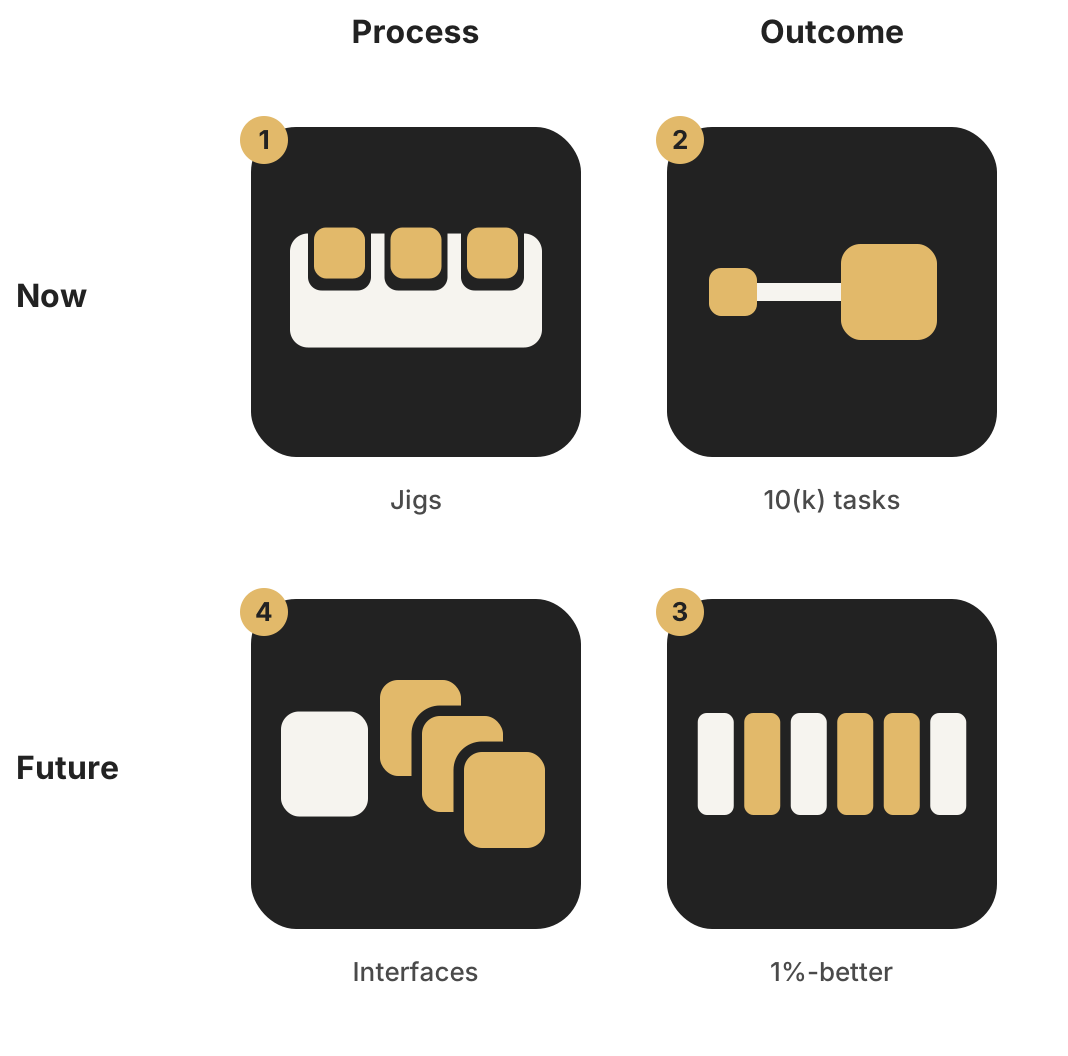
No, I haven't explained them yet. Hold your horses 😄:
For now, the numbers in the ochre circles are worth a second’s thought: They represent my suggested sequence of trying these options, sorted from easiest (”[1]”) to hardest (”[4]”), in my estimation.
Granted, grading them is a bit tricky since I don't know you. But it gives you a start. The ratings rest on the assumption that you are on a non-technical team and relatively early in your transformation journey, wondering how to get more impact from your AI effort.
If that’s you, give yourself grace and start on the simpler end unless you’re a glutton for punishment. You’ll already make progress by producing real value. And you can always accelerate or try more.
Steps for 4 no-regrets ways to create first-time value with AI
Without further ado, the actual options, in loose order of difficulty:

Jigs:
Producing your outcome with AI right away is nice. But it’s just as well to use AI just for some of the more annoying or tricky steps. That’s where jigs come in. In woodworking and other mechanical work, jigs are tools that help you do work precisely, repeatably, and quickly. For example, you might have a jig that makes sure you screw holes in the same spot for each table leg or that you cut each angle at 45 degrees exactly. (Yes, the jig is also a dance. But I’m not proposing you dance with AI.)
Credit where it’s due: In the AI context, I learned the term from Justin Massa at Remix Partners. Design leader Josh Puckett may originally have invented it.
So jigs are just a bunch of small and useful things that make all your other work simpler and less bothersome. Invest a bit of time in standardization. Their value builds up over time.
What makes them tricky is that you truly must understand whatever tasks you automate. Computers, including AI, have a nasty habit of patiently doing the wrong thing if you tell them the wrong thing. So jigs become very clear mirrors of your actual understanding of your work, meaning, even though I rate them the easiest of the bunch, they still take some effort.
The steps:
- Find something that you do over and over, ideally the same way every time.
- Get exactly clear on your steps and requirements.
- Automate it with AI.
- Make it easy to re-use and pass on to others, eg by turning it into an explicit “skill” or similar saved, portable file.
What fits it:
- Things you do over and over, the same way
- Things that you understand well enough that you will trust the automation once you’ve built it. (It’s silly to create a jig and then still check everything as if you didn’t have one in the first place.)
The possibilities are endless. For example:
- As already mentioned, a shared design system with fonts, colors, templates, and more makes every future formal output better.
- In engineering, computer code that handles file operations (finding, opening, editing, saving, closing, etc.) is only worth writing once, getting 100% right and then reusing for all future file handling.
- In math, you might have an authoritative way to complete authoritative, complext calculations, the same way every time, guaranteed.
- In project management, you might have standard completion times pre-set for certain tasks, so you never recalculate them. And on and on.
Notice how none of these jigs create value in themselves. But they still take away future pain.

10(k) tasks:
Do me a favor and follow Tobias Zwingmann, on his blog or one of the socials. This is his idea and one of many good and immensely practical ones he shares. It was also what first got me on the hunt for other no-regrets options.
Anyway, what are they?
It turns out that anything you do with AI takes longer to automate than you think it should. Surprise, right? Annoyingly, a lot of that effort comes on the tail end, after you already have an initial draft and think you're close to the end. Fine-tuning and error-proofing is a big part of AI work, and so, much of anything you'll do with AI will end up taking 10 hours (or more of course). To get return on that time investment to make sense, be sure that whatever it is you're looking to automate or have AI assist you with will save at least 10 hours a year. Or, if money is a better fit for you then time, be sure your work will save you $10,000 (or euros or pounds …).
That’s all you need to do:
- Take small-ish but real tasks you feel confident to try automating.
- Check which ones will confidently save you 10 hours or $10k per year.
- Start with the easiest one, to get a sense of what you personally can do in 10 hours.
I consider this kind of AI work another good entry point alongside jibs because it’s such a boss-pleaser. Find me any boss who wouldn't radiate with delight when you tell them, "Hey boss, would you like to save time and money in the foreseeable future?"
Good candidates for 10(k) efforts are ones that:
- Have defined beginnings and ends
- Need doing regularly
- Ideally are very well defined, in great detail
- Don’t pose existential risks if your early AI efforts leave a few bugs to be cleaned up
For example:
In my finance days, I had to print an immensely complicated report under time pressure, with ever-different page combinations and details to be shown depending on a bunch of criteria. At the time, I ended up automating that with pre-AI tools, saving about 20 hours a month. (Of course, it was also insane to realize that I had spent so much time printing and stapling. But nonetheless, it felt good to automate that work.) It was an important, well-understood, annoying repeat task with hard time savings, even if not money savings, since I was salaried, not hourly.
(P.S.: Yes, I know that a 10(k) is a Finance report in the U.S. Permit the little joke. Creating an actual 10(k) with AI is definitely possible, but much more high-stakes.)

1%-better efforts:
These efforts are ones where you improve your core work via AI automation a little bit (figuratively, 1%) every time you do it, until you’re done and the work is as automated as it can and should be.
But not all “core” work qualifies. Only pick efforts for which you can guarantee that you won’t abandon your automation work until you’ve made them good enough to call it good and to have reached significant improvements. If you have any worry that you might peter out and give up, that work is not a good candidate here.
Ah, but if you stick with it, these efforts often feel particularly good. You feel good about improving your core work, good about not facing a sudden unrealistic deadline, good to see progress (mostly), good once you overcome obstacles (occasionally), and good when you look back on the shiny and amazing automation you’ve created.
This no-regrets option is actually a bit easier to do than 10(k) tasks are. You can somewhat work at your own pace and competence level. And you do only a bit at a time. But I judged it harder overall because it’s harder for bosses to accept as a long-run time drain, and because it’s so easy to give up mid-way. Depending on your situation, those factors may matter more or less for you.
(By the way, there’s a cousin of 1%-better efforts that makes for a great challenge effort for the most ambitious among you. “Mosaic tiling” means that you take your entire team or even business and split it into individual steps, each of which you can improve, one at a time, without messing up anything else. You then replace entire workflows one at a time every time until you’ve swapped out your entire business. Hard. But very cool. Meanwhile, back to practical stuff.)
The steps:
- Describe the start and end point of your "end-to-end" process.
- Write down the high-level steps.
- Decide which of these steps you currently feel comfortable automating.
- Pick the lowest-hanging-fruit step among them and automate just that.
- On future runs of the same work, either improve the steps that you’ve already automated, or, once you feel good about prior ones, automate another step.
- Thoughtfully choose what steps to automate first. People have huge arguments about where to start. Reasonable people can very much disagree. So start where you want. Don’t let it stall you. If helpful, I for one pick steps that I have the biggest doubt about being able to automate. That way, I don’t invest a bunch of time in efforts that are unrealistic to figure out as of now. I save simple and low-value steps for last, to make my future self happy when I can tackle the last few details in one fell swoop.
- Do what you must, to ensure you absolutely can’t give up. You are doing significant work with relatively little skill. This will be hard. You are simply spreading out the work. So you don’t want to run out of steam and give up halfway through.
Good candidates for 1%-better efforts are ones that:
- Are core to your work
- Don’t involve major risks or constant boss scrutiny
- Are “must-transform”, i.e., must be “AI-native” some day. You can already tell that AI theoretically can play a big role in this work
- Must stay modern and cutting-edge in terms of quality or efficiency
- Are easy to split into parts, each of which can theoretically be done differently than the others (e.g., different tools, only depend on prior step outputs but not specific process steps)
For example:
In my startup work, I have gradually automated a core marketing process: it mattered to us to know what people are talking about online, related to our startup's work. So we collected "social signals" via Reddit, Google Alerts, and elsewhere. That was manual work. Articles had to be read, chosen as relevant, saved, organized, and eventually turned into social marketing posts or background information sheets for our sales team. By automating the process from end to end, it meant that candidates for new social media posts and finished reports for the sales team could show up automatically.
My effort to automate this work took place over several months, but I had to run this process every day. After automating the first few steps, I could simply make it slightly better every time I ran it, adding maybe 10 minutes to each run, but gradually improving the entire process. Even while I automated it, nobody else on the team really needed to be aware of the automation effort because spreading out the work meant it never caused meaningful delays.

Interfaces
A lot of modern work is just coordination with others at your org or partners. Get beyond the size of all but the tiniest startups, and you simply can’t do “entire things” anymore.
But talking to people and giving them things takes time and effort. Though some is worth it, a lot of “collaboration” and “influencing without authority” and “reporting” can feel like a slog because it’s essentially necessary but menial work.
So there’s a real benefit if you can automate more of the rote cross-team interaction and either take back the time or re-invest it where the human aspect of collaboration truly earns its keep.
Because humans have managed to make organizations so sophisticated (complicated?), this automation still comes in two different flavors:
- Standards (making things visible and common or translatable within or across orgs), to avoid the effort to translate between versions
- Self service (making your work accessible without your actual involvement), to let people get what they want when they want, without bugging you for it
To me, these are the hardest no-regret work you can do because they force you to rope in other teams. Your pretty outputs are useless if you can’t get anyone to use them.
Steps:
- List what inputs and outputs you or your team routinely use or create for others’ use: Data, reports, routine decisions, simple tools, etc.
- Pick out those that are fundamentally a waste of human time to create or communicate.
- Further boil down your list to ones that (1) you control completely either yourself or with cooperative partners and (2) don’t have contractual, compliance, or other hold-ups that keep you from changing how you do them.
- Check that automating it won’t cause crazy costs, bother, or other unintended consequences to you or others.
- Describe it at an obsessively detailed level.
- Automate.
What fits it:
- Anything soul-sucking and under your control that others need from or make for you
- For now, stick to digital-only and possible-to-digitize work. (Sorry, purely physical things like making photocopies will need to wait for better robots.)
- Things other teams can actually use once you’ve automated them.
Example:
A famous and extreme example of pulling this off at scale comes from Amazon in ~2002, with its introduction of “Service-Oriented Architecture (SOA).” The details get nerdy, … well, really nerdy. But the basics are just this: Every team had to be able to make all its output available to any other authorized team without human involvement.
Seem abstract? Consider what suddenly becomes possible: What if you and I both interview new hires. Then each of our hiring recommendations turn into data that’s accessible into posterity. Over time, HR can observe people’s careers and see answers to questions like: What actually predicts future career success or flame-out? Who is the best interviewer we have?
When you carry this through across an entire company, a lot becomes possible. But it’s also brutally hard. Tech lore has it that it took a direct mandate from Jeff Bezos, with a threat of immediate firing for anyone who doesn’t do it. And even then, it still took Amazon, a patently adaptable company, the better part of a year to pull it off. As reported by people who were there, the email with Bezos’ Big Mandate makes for amazing reading (as long as you weren’t a recipient of course).
Point is, turning your output into a self-service store is hard. But also worth it.
But I'm really ambitious. I need more!
Ok, fine.
Technically, still in the territory of no regrets. Work here, but the impact becomes a lot more hazy to measure, and so people (meaning bosses) may not recognize just how valuable this is. Too often, people confuse what's measurable with what's valuable. Don't say I didn't warn you. But if you can sidestep that problem, here I'll collect more options, described more briefly:
Standards
At many companies, individual teams have defined the same things in different ways. For example, one company with which I worked had three different ways to define revenue. Each method made sense, but the three were difficult to integrate or translate.
So you can make things better by using AI to make knowledge visible, common, or translatable.
E.g., let's say you're at a retailer, and they define revenue once by store, once by product type, and once at the total company level. In that case, if you can create a database or math rules that describe how one turns into the other, you've provided something really valuable to the company. Now you can see revenue by item, by store, in a way that ties back to earnings per share at the highest level.
you would use AI in two places here, even though the actual math is deterministic and just regular calculations or regular code:
- AI can help you dig through the many details to figure out how to translate things in the first place.
- You might use AI to create a dashboard, or a simple app, or something else that offers up the translated knowledge or the ability to translate and see the translation live for any authorized user who wants it.
This is valuable because you save yourself a massive initiative that forces everybody to use the same calculations. Everybody can still use what they have and are familiar with. It's now just possible for everybody else to understand it too
Capabilities
There are things that you've always been wanting to be able to do but haven't. Now is your chance to build them. That, too, is valuable. It either improves your productivity or your capabilities on some front, but it's hard to measure that ROI because nothing disappears. You just do your work better in some way.
E.g., with one client, we wanted to get a much better sense of what our ideal user population was facing as issues worth solving, but spending hours to track Google Alerts and Reddit posts was just not in the cards. So we built an AI-based marketing signal tracker that collected what people said, assessed what we could learn from it, and spit it out in a report.
Very helpful. Definitely made us better. But value spreads over time. So it's hard to pin-point to a skeptic.
What other ideas does this give you?
Just get started
I hope that this set of options gave you ideas for no-regrets work that you can do to get practical value from your AI work. Maybe these specific options work for you. Maybe you came up with others within our four types, creating value now or later, via better steps or better output.
But the specific choice matters less than just starting. Remember my early point about “change ownership.” In the end, progress depends on you. You need to own change these days. Your org probably won’t and maybe can’t even do it for you. Luckily, good AI itself (Claude, Codex, Copilot, whatever your drug of choice) can help to teach you new skills or give you ideas for applications. So if you’re totally stuck, use AI to help you get value from AI.
I wish you luck, patience, curiosity, and loads of impact!
Sources & further reading:
- Zwingmann, Tobias. "Profitable AI Blog." https://blog.tobiaszwingmann.com/